Comparing Two Vice Presidents—John C. Breckinridge and JD Vance

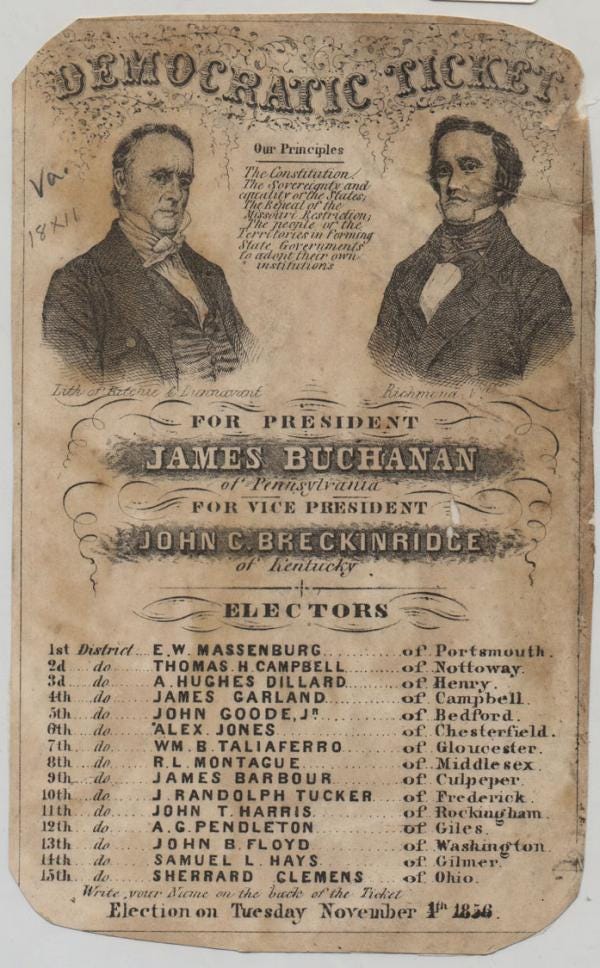
John Adams, our first vice president, called the job “the most insignificant office that ever the invention of man contrived or his imagination conceived.” We shouldn’t take these words literally, since he was prone to hyperbole. While being VP may not carry much day-to-day responsibility, it’s only a “heartbeat away” from the presidency. Political parties have traditionally picked the number two spot based on the need to “balance the ticket” with the presidential candidate. In 1856, the Democratic Party—divided between its Northern and Southern constituencies—nominated 65-year-old James Buchanan of Pennsylvania for president, and 35-year-old John C. Breckinridge as his running mate. The 30-year age difference for these two candidates reminds me of Donald Trump and JD Vance, when he was chosen as VP nominee in 2024. Both Breckinridge and Vance were young men picked to be the vice presidents of elderly candidates. However, Breckinridge had a charming nature no one would accuse JD of possessing. Indeed, Buchanan’s vice president was called a “most noble looking man – a ladies’ man” with “such piercing blue eyes I never saw before.”
One challenge to self-government is the propensity of its ideological enemies to gain power to damage the system. Breckinridge and Vance both supported groups hostile to democracy. For the Kentuckian, it was the Confederacy, and for the writer of Hillbilly Elegy it was—and still is—fascist movements like MAGA and AfD in Germany. To these two men, then, oaths of office to “preserve, protect, and defend the US Constitution” weren’t worth much more than the paper they were printed on. What do you think JD’s “Mamaw” would say about that?

In the 1860 presidential election, the Democratic Party split into Northern and Southern factions. The former nominated Stephen A. Douglas—the former debating opponent of Abraham Lincoln—and the latter chose John C. Breckinridge. While Northern Democrats had no objections to slavery, they disagreed with their fellow party members from South of the Mason-Dixon over their desire for an evil-sounding idea called a “Slave Code for the Territories.” Such a law would have legalized unfree labor by default in all the US’ territories. Northern whites believed white males should have been able to vote on the issue—so-called “popular sovereignty”—even if they didn’t want to hear the opinions of Black people. Douglas and Breckinridge had once been friendly colleagues in Washington D.C., but their friendship ended once their party became divided. Even had there been no split among the Democrats, Lincoln, the Republican candidate, still would’ve won a majority of electoral votes had the results otherwise remained the same.
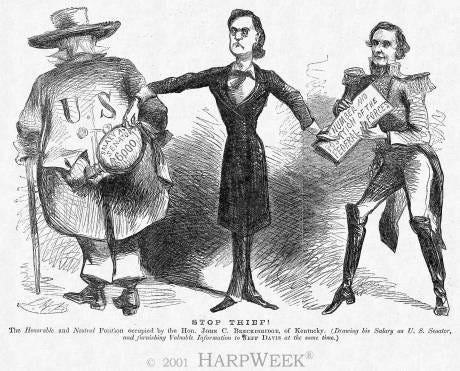
On March 4, 1861, Breckinridge traded being vice president for being one of Kentucky’s senators. Like many of his neighbors in the “Bluegrass State,” Johnny deluded himself into thinking he could be “neutral” in the early Civil War. When push came to shove, the former vice president sided with the Confederacy and donned a gray uniform in the fall of 1861. In response, the U.S. Senate expelled Breckinridge. After betraying his oath of office as vice president, Breckinridge’s beloved CSA was defeated at Appomattox. Hopefully MAGA will rest on the shitheap of history, too.